
Frequently Asked Questions

Arizona law (ARS 43-1089) allows you, as a tax payer, to direct your Arizona state tax liability to School Tuition Organizations such as Catholic Education Arizona. This is a dollar for dollar tax credit against what you owe the state of Arizona. The funds are used exclusively for the cost of tuition at private schools which include our Diocesan Catholic schools.

Everyone pays state income taxes unless you are taking a loss or don’t have earned income. Even if you receive a state tax refund, you have paid state income taxes. Take a look at your last year’s tax return to determine how much you pay in state income taxes. Check Line 48 on Arizona Tax Form 140 or Line 58 on Arizona Tax Form 140PY. The amount found on these lines is your tax liability from last year. Checking last year’s tax liability, will give you an idea as what you can direct to Catholic Education Arizona this year, up to the maximum tax credit amount allowed by law.

The 2025 Arizona Individual tax credit limits are $1,535 for single / $3,062 for married filers.

The 2026 Arizona Individual tax limits are $1,571 for single / $3,131 for married filers.

  • Tax Year 2025 – 4/15/26
  • Tax Year 2026 – 4/15/27
Of course! You can contact the CEA office directly at 602-218-6542 to schedule monthly contributions if that best suits your family’s budget. Or you can schedule monthly contributions online.
Any Arizona taxpayer, single or married, with an Arizona tax liability.
Financially qualified students who have demonstrated need are the recipients of the tax credit scholarships through Catholic Education Arizona.

Yes. You can contribute online in just minutes.  Make your contribution on this website, using the Contributor Portal or First Time Contributor options.  You will be able to review and manage your entire contribution history if you choose to use the contributor portal.   Once your contribution is confirmed, a tax receipt will be promptly emailed to you. Or you can print a tax receipt from your contributor portal once the contribution is confirmed.

As a 501(c)(3) organization, Catholic Education Arizona does not accept tax contributions designated for specific students. However, you may direct your tax credit contribution to one of our Catholic schools or multiple Catholic schools.
Catholic Education Arizona (CEA) is a separate 501(c)(3) not for profit “School Tuition Organization”. It operates separately from the Diocese of Phoenix. CEA supports 38 Catholic schools throughout the Diocese of Phoenix and including scholars of Hope Ignites, formerly Boys Hope Girls Hope of Phoenix.
All students enrolling in one of the 38 diocesan schools (K-12) each year, is welcome to complete a scholarship application form. The primary criteria for awarding scholarships is financial need. Catholic Education Arizona strives to assist as many financially qualified students as possible every year by increasing tax credit contributions for our schools. Catholic Education Arizona strives to assist as many financially qualified students as possible every year. Upon confirmation that a student/family is approved for tuition funding, the funds are sent by CEA directly to the school the student attends.
The amount you direct to CEA, is a dollar-for-dollar state tax credit. This is different from a tax deduction. Tax deductions reduce your taxable income. A tax credit is a dollar-for-dollar credit against the taxes you have paid to the state of Arizona. The funds are being directed to CEA rather than to the state.

Yes! Follow 3 easy steps:

  1. Find out how much you can contribute by reviewing your tax liability from last year
  2. Make your contribution by completing a contribution form found on this website, or contribute online or call CEA at 602-218-6542
  3. Claim your tax credit with the tax credit receipt you will receive from CEA
Yes. As long as you have enough of a state tax liability, you can “stack” tax credits.

You can indicate the school(s) you wish to support on the second page of the online contribution form. If you mail in your contribution, there is a section to list the school(s) of your choice on your contribution form.
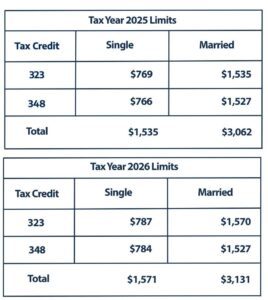
The 2025 Arizona Individual tax credit limits are $1,535 for single / $3,062 for married filers.

ADOR Website


Both tax forms 323 and 348 are available for downloading on this website.

Tax Year 2024

Catholic Education Arizona does not submit your contribution information to the state of Arizona or the IRS. Each contributor files tax forms 323 and 348. Submit these forms together with the tax receipt you receive from CEA to your tax preparer or Turbo Tax. Your receipt confirms your tax credit contribution to CEA. We call this “taking the credit”.

You may direct 100% of your corporate state tax liability to CEA on behalf of our schools. Corporate contributions to School tuition Organizations (STO’s) such as CEA, range from the $5,000 minimum for S-Corps to $1.5m or more.

CEA uses an independent firm, FACTS to review all tuition scholarship applications we receive for eligibility.

By law, Corporate Low Income Tax Credit funds are dedicated exclusively to the tuition needs of children living within the poverty guidelines as determined by state and federal standards. Disabled/Displaced funds are dedicated to those students with an MET, IEP, or 504 plan from an Arizona public school or was at one time placed in the Arizona foster care system.

Commitments for a corporate tax credits are accepted year-round. Applications to the DOR will be submitted when tax credit dollars are available. Call us for additional information.

Each year, the State of Arizona limits the total amount of corporate state tax funding that can be used for distribution to private schools. The annual statewide cap for FY25 to FY26:

  • Low-Income Fund is $135,000,000
  • Disabled/Displaced Fund is $6,000,000

Apply online at FACTS.

The Round 1 application for the 2026-27 school year opens on February 1, 2026, and closed on April 15, 2026.

The Round 2 application will opens April 15, 2026 and closes on Aug. 21, 2026.

Applications received after August 21, 2026 will be accepted and awards based on available funding.  Please contact your school for additional information.

.

Only one application per family is required.

FACTS charges a $31 application fee per family.

  • Income information from your most recent tax return
  • Dependent information for all dependents that you claim on a tax return including college students and children not yet enrolled in school.
  • Monthly expenses (i.e. mortgage, rent, car payments, etc.)
  • Special Circumstances (i.e. job loss, medical issues, etc.)

You must complete a Statement of Income form as well as meet with your school principal to explain your situation. The principal will sign the Statement of Income form and provide a letter stating they have met with your family.

Please provide FACTS with a copy of your extension, your previous tax return, and most recent W-2 information. FACTS will follow-up with additional questions if needed.

Please explain your change in income in the Special Circumstances section of the application. FACTS will request any additional documentation if needed.

No. Select the school you are leaning towards most. If you change your mind, email info@ceaz.org and advise of the school change.

No. You are not able to make changes once you have submitted your application. Please email info@ceaz.org.

Both CEA and your school have access to your award letters for the current and prior years. Please contact either of us for help. Please include your student’s name and school in your request.

Yes. There is a Public School Verification form that should be included in your registration packet from your school that you will need to have the public school complete for you. You will return the completed form to your school.

No, your application and supporting tax/income documentation should be submitted through FACTS.

No, a student who receives ESA funds cannot receive ANY STO FUNDS FOR THAT SAME ACADEMIC year.

Yes! However, schools can only accept funding equal to the student’s tuition that is due for that year. Any surplus funds must be returned to the STO.